

Vegetative phase
Building a plant able to feed a hungry fruit
GoalQuickly develop a powerful root system and a large leaf area, able to produce enough energy for the fruiting to come.
- 01
Establish the roots
Over the first weeks, keep the substrate evenly moist without holding it constantly soaked.
Moderate but regular watering lets the roots explore the available volume. Alternating between wetting and a slight drop in moisture can also encourage them to colonise the substrate.
Keep an eye on
- soil moisture
- soil temperature
- pH
- electrical conductivity (EC)
- vigour and colour of the new leaves
- 02
Build the canopy
Once the root system is well established, nutrient needs rise along with the plant’s growth.
Nitrogen then plays an important part in building leaves and vines, but it must not be overused. A plant overloaded with nitrogen can produce a lot of foliage without necessarily improving its future ability to carry a big fruit. Potassium, calcium, magnesium and micronutrients must also be available in a balanced way.
Principle : Aim for fast growth — but above all, steady growth.
- 03
Increase irrigation gradually
The larger the leaf area, the more the plant transpires and the more water it drinks.
Irrigation must therefore follow the plant’s growth rather than stay based on a fixed amount.
It is better to split the inputs once demand gets high, so that water stays available without keeping the soil saturated for long periods.
Pre-fruiting
Preparing the fruit to come
This period matters especially: the plant already has a large growth capacity, but it now has to be prepared to feed a fruit that will become extremely demanding.
- 04
Rebalance the feeding
As flowering and fruit set approach, you gradually shift from feeding aimed mainly at vegetative growth towards feeding able to support the fruit production to come.
Potassium becomes particularly valuable, supporting sugar transport and water regulation. Calcium stays essential for tissue strength and for the working of young organs. Magnesium and micronutrients, for their part, keep photosynthesis efficient and drive many metabolic reactions.
Careful : This transition must be gradual. An abrupt change in fertilisation can cause a nutritional imbalance or osmotic stress.
- 05
Get the irrigation ready
From the moment the fruit is set, its water demand rises fast. You therefore need an irrigation system able to follow that increase.
The aim is a sufficiently stable moisture level in the root zone, especially through hot spells, without swinging between very dry and saturated soil.
- 06
Observe rather than follow a recipe
Two plants of the same variety can have very different needs depending on:
- the size of the plant
- the leaf area
- temperature
- air humidity
- soil type
- water-holding capacity
- root volume
- the load of the fruit
The plant must therefore remain your main indicator.
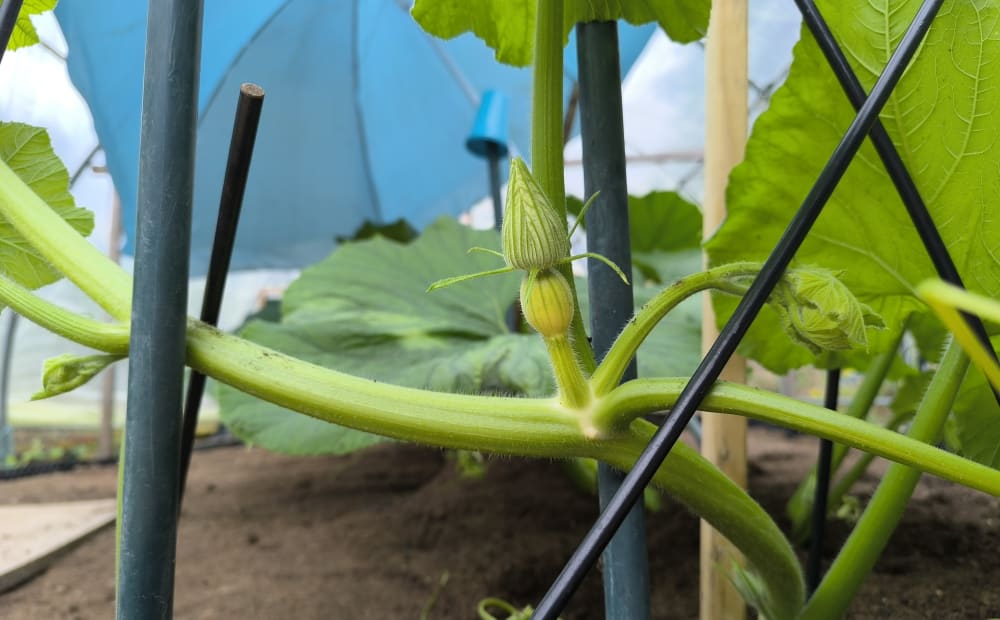


Fruiting
Feeding the fruit
This is the phase where needs can become impressive. A giant in full growth can drink and eat a great deal. But raising the doses without control is not necessarily beneficial.
- 07
Raise the water with the demand
Once the fruit starts putting on weight quickly, irrigation must keep up with its growth.
How much water is needed depends heavily on the climate and the size of the plant. In hot weather, evapotranspiration can rise considerably.
So work from the plant’s real consumption rather than a fixed number of litres per day.
Keep an eye on
- root zone moisture
- air / soil temperature
- how the fruit’s growth is progressing
- the state of the leaves
- drainage
- EC of the soil or the nutrient solution
- 08
Keep the feeding balanced
While the fruit fills out, potassium takes an important place in the feeding. However, "more potassium" does not automatically mean "more growth".
An excess of one element can disturb the uptake of others. The aim is therefore to keep a balance between potassium, calcium, magnesium and the other essential elements.
Nitrogen does not have to be cut out: a plant that keeps producing and maintaining a large leaf mass still needs it. You simply avoid over-stimulating the foliage at the expense of the overall balance.
- 09
Split the inputs
When consumption gets very high, several small applications can be easier to manage than a single massive one.
It notably limits big swings in moisture and in salt concentration around the roots.
The aim is to keep a root zone that is active, moist and oxygenated.
Monitoring
The key to a giant
A good nutrition strategy does not rest on fertiliser alone.
You have to learn to read the plant and, where possible, measure its environment.
The indicators worth following
The plant
- growth rate of the new leaves
- colour of the foliage
- leaf size
- vine vigour
- any symptoms appearing
The water
- amount applied
- watering frequency
- air / soil temperature
- pH
- EC
The soil
- moisture
- temperature
- pH
- EC
- structure and drainage
The fruit
- circumference
- estimated weight over time (OTT: Over The Top)
- daily growth rate
"We are not trying to give the plant the maximum. We are trying to give it the maximum it is able to use."
- Feeding too lightly limits growth.
- Feeding too heavily can raise salinity, disturb nutrient uptake and cause root stress.
- Insufficient irrigation limits photosynthesis and the transport of assimilates.
- Excessive irrigation can reduce root oxygenation and encourage root problems.
The best result therefore comes from a progression matched to the plant, the climate and the fruit’s growth rate.