
- 01
Choosing the right fruit: selecting the champion
Preparation starts long before the weigh-in: everything hangs on the choice of fruit.
- Pick the right variety : some lines are bred specifically for competition (e.g. Atlantic Giant for cucurbits).
- Look at the shape : favour a symmetrical fruit, without excessive hollows or bumps.
- Check the stem : it must be healthy, strong and firmly attached, because a weakened stem can lead to a split or a break.
- Limit the number of fruit per plant : keeping a single fruit maximises the nutrients reaching it.
- 02
Preparing the fruit as it grows
Once the fruit is chosen, the daily work begins.
- Support the fruit : place a porous mat or a bed of sand under it, to keep off damp and pests.
- Control the orientation : never turn the fruit abruptly; if you must, do it very gradually when temperatures are high, to avoid tearing.
- Controlled watering : keep moisture constant without excess. Drip irrigation is ideal.
- Regular feeding : solid or liquid amendment of organic origin.
- Hand pollination : for squash, pumpkins, watermelons… it improves the odds of a well-formed fruit. Usually in the morning, around 8–10 a.m.
- 03
Watching the fruit’s condition
A champion is also won through vigilance.
- Daily inspection : look for splits, pests, soft spots, and any tension building between the stem and the fruit.
- Shade it from direct sun : put up a shade cloth to prevent scorching.
- Manage the fast growth : fruit can put on several kilos a day, so check that the support keeps up.
- Avoid knocks : never rest objects on the fruit, and don’t walk too close.
- 04
Measuring properly before the competition
Competitions often use the OTT (Over The Top) method for cucurbits. Three essential measurements:
1Circumference
Around the fruit, parallel to the ground.
2End-to-End
From the ground up to the stem, over the fruit, back down to the ground at the blossom end.
3Side-to-Side
Perpendicular to the previous one, ground to ground.
Together, these three give a volume, and so an estimated weight before the official weigh-in.
- 05
Transporting the fruit safely
Transport is often the riskiest stage.
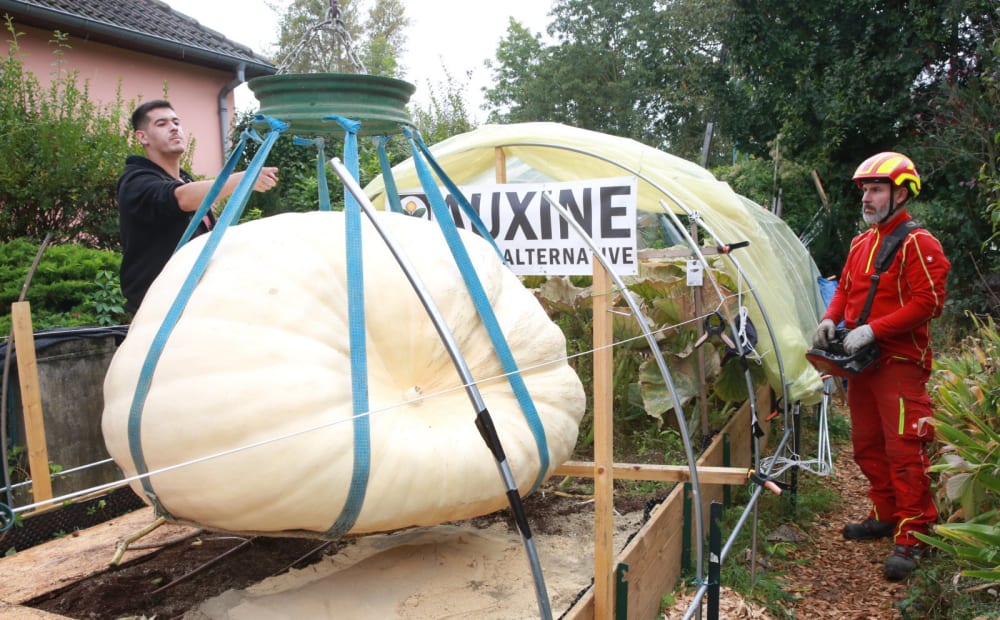
- Use a wide strap or a transport hammock
- Never lift it by the stem
- Steady the fruit with foam wedges
- Avoid jolts : a split fruit is disqualified.
- 06
Getting ready for the official weigh-in
On the day, every detail counts.
- Clean the fruit gently : remove soil, dust and debris.
- Check its integrity : no split, no puncture.
- Present the fruit with its stem intact : unless the rules say otherwise.
- Arrive early : some competitions require a prior inspection.
- 07
The spirit of the competition
Beyond the weight, judges look at:
- the overall quality of the fruit
- the shape
- the colour
- the presentation
- compliance with the rules
← All growing tipsGuide
Preparing a fruit for competition
From selecting the fruit to the official weigh-in — the champion’s moves.
A competition fruit is not won on weigh-in day: it is prepared across the whole season, then protected all the way to the scale. Here are the seven steps I follow, in order.
A word you don’t know? Technical terms are underlined: hover them (or tap them) for the definition.See the whole glossary →
A podium starts with a seed.
Our elite lines come from weighed, documented fruit.
View the elite range